
Is a 350-Guest Hall the Right Size for Your Show in Arlington, TX?
Arlington is known for very large rooms. The stadium tours play AT&T Stadium and Globe Life Field, and Texas Live! runs its own entertainment calendar. Those places are 1.7 to 2.5 miles from us, and they are not where you put a band's album release, a school concert or a tribute night for a few hundred people.
Our hall is the other kind of room: a private event venue in Arlington, TX that holds up to 350 guests and already has a stage in it. You rent it for your date, you decide who comes in, and the show is yours to run.
It is a good match for:
- a local band's album release or anniversary show
- a tribute night or a themed dance night with a live band
- a church, school or studio concert, or a student recital
- a cultural music night for a community association
- a fundraiser concert with tables and a program
- a comedy night, a talent show or a showcase
It is not the right room for a show that needs more than 350 people in the audience, and it is not an arena with a touring production crew on staff. If you expect to sell more than 350 tickets, look at a larger room. If you expect 80 to 350 people and want a stage, lights, sound and a bar without building them from nothing, keep reading.
What Is Already in the Room for a Live Show?
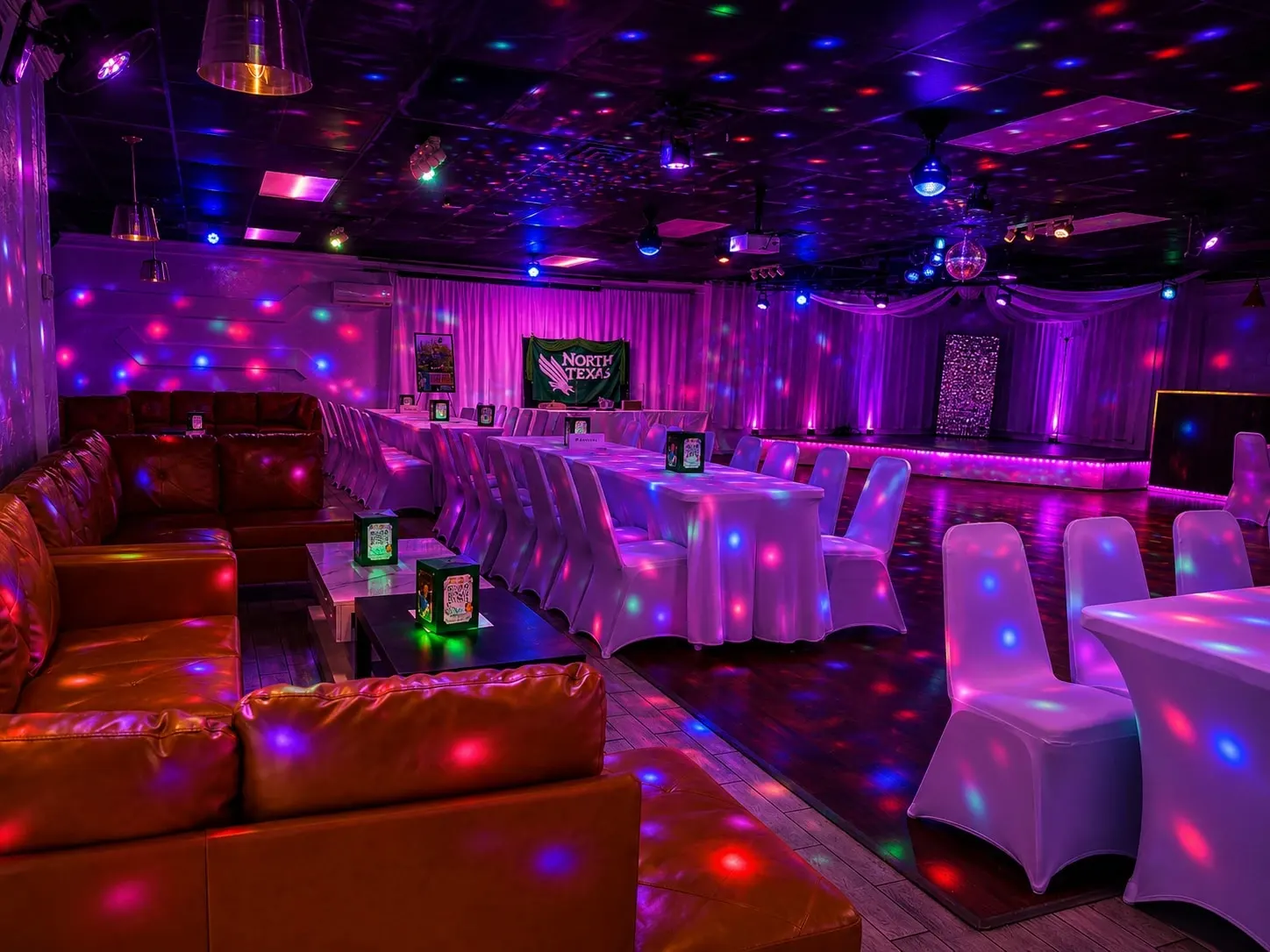
Most of the cost and stress in a small concert comes from renting things one by one: a stage deck, lights, speakers, a place for the performers to change. Here those pieces are part of the hall.
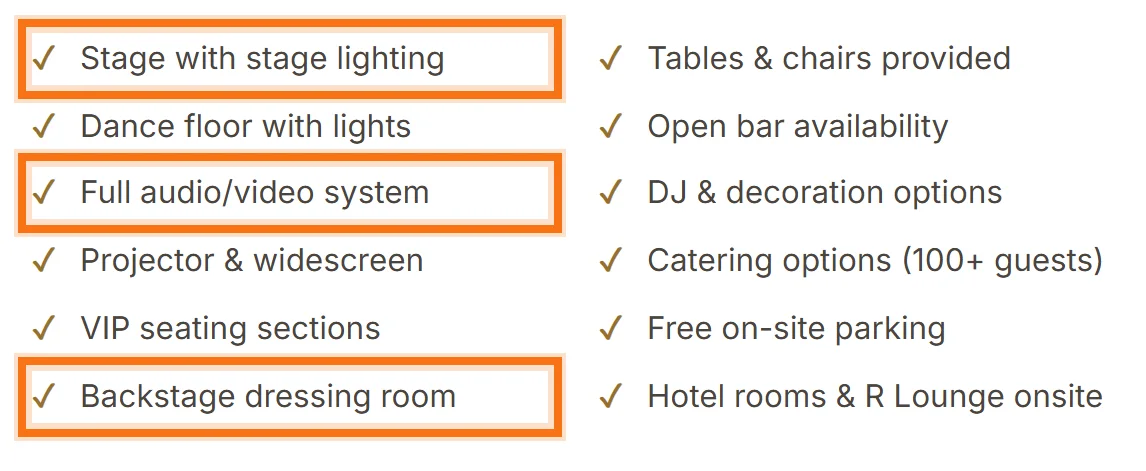
- Stage with stage lighting. A fixed place for the performance, lit separately from the room.
- Complete audio/video system. The Venue + Audio/Video package lists a power sound system, an overhead projector and a widescreen.
- Dance floor with lights in front of the stage area, for shows where people will get up and move.
- Backstage dressing room for performers.
- VIP seating sections for sponsors, family, or a higher ticket tier if you plan one.
- Two bars, with open bar available.
- Tables and chairs, and flexible layouts.
What we do not publish, and what you should not guess: the stage measurements, the electrical supply at the stage, the make and power rating of the speakers, and whether someone operates the system for you. Every band's needs are different, so these are questions for event sales, and the checklist further down lists all of them in one place.
The projector and widescreen are worth a second thought. Organizers use a screen for sponsor logos, a slideshow before a memorial or benefit concert, lyrics for a worship night, or the name of the act on stage. Tell us what you want to show and how you will supply it.
Which Layout Fits Your Kind of Show?
The same floor works very differently for a recital and for a tribute band. Decide what the audience will be doing for most of the night, then ask for a layout built around that.
Seated in rows. Best when people are there to listen: recitals, choir and school concerts, comedy, talent shows. Everyone faces the stage and nobody has to turn a chair.
Seated at tables. Best for fundraiser concerts, cultural nights and dinner shows, where guests eat, talk between sets and stay for hours.
Open floor in front of the stage. Best for a band people want to dance to. The dance floor with lights sits where the audience naturally gathers, with seating around the edges for those who want to sit.
Mixed. Many shows use a bit of each: an open floor in front, tables behind, and the VIP seating sections for sponsors or guests of the performers.
Type of show, the layout to ask for and the package to discuss first
| Type of show | Layout to ask about | Package to discuss first |
|---|---|---|
| Album release or local band night | Open floor in front of the stage, seating at the sides, VIP sections for guests of the band | Venue + Audio/Video |
| Tribute night or dance night with a live band | Dance floor open, tables around it | Venue + Audio/Video |
| Church, school or studio concert; recital | Rows facing the stage; widescreen for lyrics or a program | Venue + Audio/Video |
| Cultural music night | Tables for families, dance floor open, VIP sections for elders or honored guests | Venue + Audio/Video, or Full Service with Catering for 100 guests or more |
| Fundraiser concert with dinner | Tables with a clear view of the stage and the screen | Full Service with Catering (currently a minimum of 100 guests) |
| Comedy night or talent show | Rows or small tables close to the stage | Venue + Audio/Video |
| Show with a DJ before or after the live act | Dance floor open, seating at the sides | Venue + AV, Decoration & DJ |
How to read this table: find the row closest to your show and take the layout and the package to event sales as a starting point, not a final answer. How many people fit in each layout depends on the stage plot, the tables and the bars, so ask for the working number for your layout rather than assuming 350 in every setup.
If your event is a celebration with music more than a show with an audience, our guide to the dance floor, DJ setup and stage for private parties is the better read. For how guest count changes the room, see planning a large event by guest count.

Which Package Should a Concert Organizer Start With?
We have four event packages. We do not publish prices; each event is quoted by date, guest count and package. For a show, the choice usually comes down to how much production you are bringing yourself.
- Venue + Audio/Video is the natural start. It lists an event window of approximately 4 to 7 hours, the power sound system, the overhead projector and widescreen, stage lights and dance floor lights.
- Venue Only lists approximately 4 to 6 hours, open bar, and tables and chairs. Organizers ask about it when the band travels with its own full sound and lighting. Whether outside production can be used, and how, is a question for event sales before you choose it.
- Venue + AV, Decoration & DJ adds decoration services, a DJ with the sound system, table and chair arrangement, and cleaning. It fits a night where a DJ carries the room before and after the live set.
- Full Service with Catering adds setup time and catering service, and currently requires a minimum of 100 guests. It fits a dinner concert or gala.
Two things to raise in the first call. First, bringing your own sound engineer or backline (drum kit, amplifiers, keyboards): tell us what the act travels with and ask how it works with the house system. Second, the event window: ask whether load-in, sound check and load-out sit inside those hours or around them. A three-hour show can need a much longer day.
The four packages compared side by side goes through each one in more detail.
What Should You Ask Before You Book the Room?
This is the part most organizers skip and regret. A hall can be perfect on paper and still fail your show on one detail, such as a drum riser that does not fit or doors that open an hour later than the band expected. None of the answers below are published on our site, because they depend on your act and your date. Get them from event sales, in writing, before you announce the show.
Technical and booking questions to settle with event sales
| Question to ask | Why it matters | Who gives the answer |
|---|---|---|
| What are the stage's width, depth and height? | Your band's stage plot has to fit: drums, risers, a choir, dancers. | Event sales, checked against the band's stage plot |
| What power is available at the stage? | Amplifiers, keyboards and extra lighting need enough outlets and circuits. | Event sales; your sound engineer says what the act needs |
| What does the house sound system include, and who runs it? | Microphones, monitors and mixing channels decide whether you bring extra gear and an engineer. | Event sales and your sound engineer |
| Can we bring our own engineer, speakers or backline? | Many acts sound best on their own equipment; the venue has to agree to how it connects. | Event sales |
| Where and when do we load in and load out? | The band needs to know which door, how far from the stage, and how early. | Event sales |
| Do sound check and setup count inside the event window? | It changes how long the show itself can run. | Event sales |
| What time must the music end? | Your set times, your encore and your ticket wording depend on it. | Event sales |
| Can we sell tickets in advance and at the door? | A public ticketed show is not the same as a private party; get the rules first. | Event sales |
| How many people fit in our layout, seated and standing? | The hall takes up to 350 guests; the number you can sell depends on the setup. | Event sales |
| Is security required, and who arranges it? | It affects your budget and your door plan. | Event sales |
| How do the bars work for our show, and are all ages allowed? | School, church and family shows need a different plan than a late band night. | Event sales |
| Do we need event insurance? | Some organizers must show a certificate before the date. | Event sales; then your insurance agent |
| Can we sell merchandise, and where? | A table near the entrance or a bar is income for the act. | Event sales |
| What are the deposit, payment and cancellation terms? | Ticket sales come in late; your payments to the venue may not. | Event sales |
How to read this table: send the first six rows to your band or sound engineer and ask them to add their own needs, then bring the whole list to one call or visit. If an answer changes your plan, for example the end time or the working capacity, it is far cheaper to learn it before the posters are printed.
It also helps to visit the hall with the person who will mix the show. To set that up, send the event inquiry form or call Rina in event sales at 972-352-0888.
Where Do Performers Get Ready, and Where Do the Band and Fans Stay?
The backstage dressing room is a small thing that changes a show. Performers have a place to change, warm up, leave cases and wait out of sight between sets. For a recital or a school concert it becomes the holding room for the next group. Ask how many people it suits and how it connects to the stage, so you know whether a large choir or dance group needs a second waiting area.
The hall is part of a hotel, so the people who travel for the show can sleep on the same property. We have eight room types, from Standard King to Studio Mini Kitchen 2 Queen. Two queen rooms sleep up to four, which suits band members sharing. Rooms have mini-fridges and coffee makers, and Wi-Fi, parking and breakfast are free. Rates change by date, so check live availability or call the front desk at 817-652-3100.
If several rooms are needed for performers, crew or fans coming from out of town, ask about a group room block when you inquire about the hall. Our guide to planning hotel rooms and event space together explains how the two requests fit.
Reception is open until 2:00 AM Sunday through Thursday and 3:00 AM on Friday and Saturday, so performers who finish late can still check in at the desk on most show nights.
R Lounge Bar is on the property too. It is the hotel's own bar and is separate from your hall rental. We do not publish its schedule, so contact the hotel for current hours if your guests ask where to go before or after the show.
How Do the Bars Work on a Show Night?
The hall has two bars, and open bar is available. With a few hundred people and a short break between sets, two service points matter: the line splits and people get back to the stage before the music starts again.
How drinks are handled is different for a concert than for a wedding. At a private party the host usually pays. At a ticketed show the audience often expects to buy their own. Tell event sales which one you have in mind and ask what is possible for your date, including what applies when part of the audience is under 21.
Plan your intermission around the bars. One longer break usually works better than two short ones, and an announcement from the stage five minutes before the next set brings people back. Our guide to booking a venue with a bar covers the bar questions in more depth.
For a dinner concert, catering is part of the Full Service with Catering package and currently requires at least 100 guests. For other food ideas, ask event sales what is allowed.
What Does a Show Day Look Like?
The schedule below is an example to plan from, not hotel policy. Your real times come from the event window in your package and from what event sales confirms for your date. It assumes one opening act and one main act.
- About 4 hours before doors: load-in. Production and backline go in first, then instruments.
- About 3 hours before doors: stage set and line check. The engineer tests every microphone and input.
- About 2 hours before doors: sound check, main act first and opening act last, so the stage is already set for the opener.
- About 1 hour before doors: the room is finished. Tables or rows are checked, the ticket and merchandise tables are staffed, the screen shows the welcome slide, and the bars are ready.
- Doors: background music, guests find seats, the bars are busy.
- 45 to 60 minutes after doors: opening act.
- Break: changeover on stage, bars open, sponsor or host announcements.
- Main act, ending at the time you agreed with event sales.
- After the show: guests leave, the act packs down and loads out, and the organizer walks the room with the venue.
Print this as a one-page run sheet with names and phone numbers next to each step, and give a copy to the band, the engineer, the person on the door and event sales.
Community groups often run a longer program with several short acts. If that is your night, the guides to Hispanic and cultural celebrations in the hall and church event hall rental show how other organizers structure a multi-part evening.
How Do Your Audience and Performers Get Here, and How Do You Book?
We are at 1175 N Watson Rd, Arlington, TX 76011, on the SH 360 frontage in the Entertainment District, between Dallas and Fort Worth. Put the full address on tickets and posters. On-site parking is free, which matters when a few hundred people arrive in the same half hour.
Performers who fly in land at DFW International Airport, approximately a 15 to 20 minute drive, or Dallas Love Field, approximately 30 minutes depending on traffic. We do not run a shuttle, so plan a rental car or rideshare for the act and its gear.
For visitors making a weekend of it, Six Flags Over Texas is 0.7 miles (about 1.1 km) away, Globe Life Field 1.7 miles (2.7 km), Texas Live! 2.1 miles (3.4 km) and AT&T Stadium 2.5 miles (4 km). Check the stadium calendars before you fix a date: a big game or tour night the same evening changes traffic and hotel demand across the district.
To start, tell us five things: the date or dates you are considering, the kind of show, the audience size you expect, whether it is ticketed or by invitation, and what the act brings with it. Then:
- Request availability with the event inquiry form. Submitting the form does not confirm a booking; event sales confirms availability.
- Call Rina in event sales at 972-352-0888.
- See the room set for dinners and receptions on our banquet hall page.
Ask for a visit before you sign. Stand on the stage, look at the room from the back row, and go through the checklist above with the person who will run your sound.
